New study from the RVC provides framework for understanding mobility loss with age
New research from the Royal Veterinary College (RVC) has revealed why goal-directed movements in mammals become slower and less precise with age, identifying key muscle changes responsible for this deterioration. The findings provide a clearer framework for understanding movement decline in humans and animals and could help guide future research into maintaining mobility.
In humans, age-related changes in muscle function are closely linked to an increased fall risk. Falls are one of the leading causes of injury and death in older adults, with approximately one-third of people over 65 in the UK experiencing at least one fall each year. Beyond human health, age-related muscle decline also affects many animal species. This includes domestic animals such as horses and dogs, where conditions like sarcopenia - the gradual loss of muscle mass and strength with age - are recognised clinical concerns. By identifying which muscle changes have the greatest impact on movement, these findings could help inform more targeted interventions, including approaches to rehabilitation, physiotherapy and mobility support in both human and veterinary medicine.
Published in PLOS Computational Biology, the study was conducted by Dr Delyle Polet, and Professor Christopher Richards at the RVC’s Structure and Motion Laboratory, which has a long-standing international reputation for multidisciplinary research and state-of-the-art facilities.
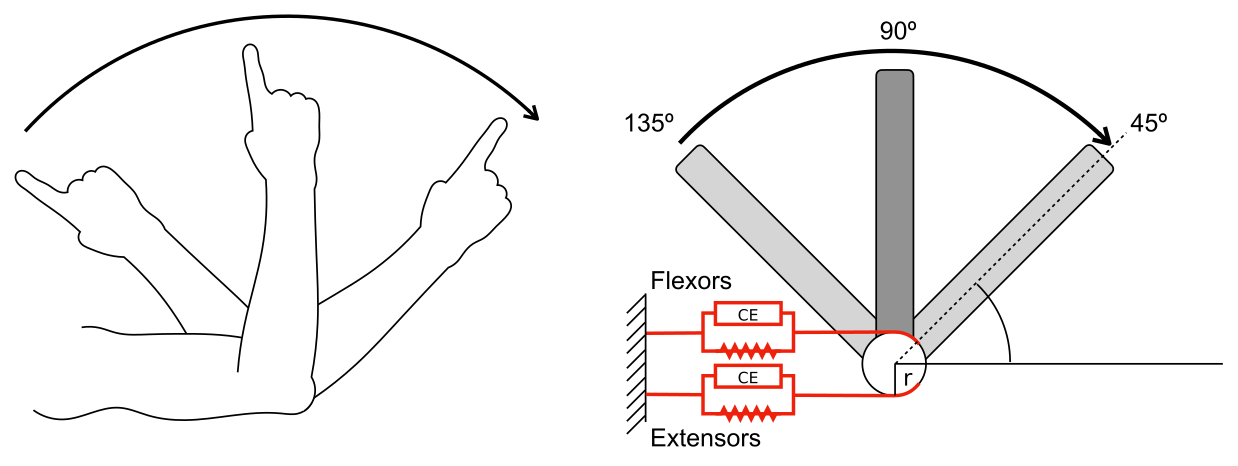
Together, the researchers developed a computational model to isolate and investigate the effects of individual muscle properties in a way that is not possible in human studies alone. Using empirical studies of human and mammalian muscle physiology as model parameters, they built a simplified digital model of a human elbow joint powered by two opposing muscles.
The team conducted 3,920 simulations, using a technique called optimal control to find the best possible muscle activation patterns for moving the arm from one position to another as quickly and accurately as possible. Assessing these findings, they were then able to calculate how the model arm reached its target under different conditions by varying five key muscle characteristics known to change with age. These are peak force, peak contraction speed, activation rate, deactivation rate and stiffness.
The simulations revealed that reduced muscle strength, contraction speed and activation rate all independently reduce performance and are the main factors behind slower and less accurate movement. However, when muscle stiffness and deactivation (the time it takes for muscles to switch off) function together in a specific manner, they can improve rather than hinder performance.
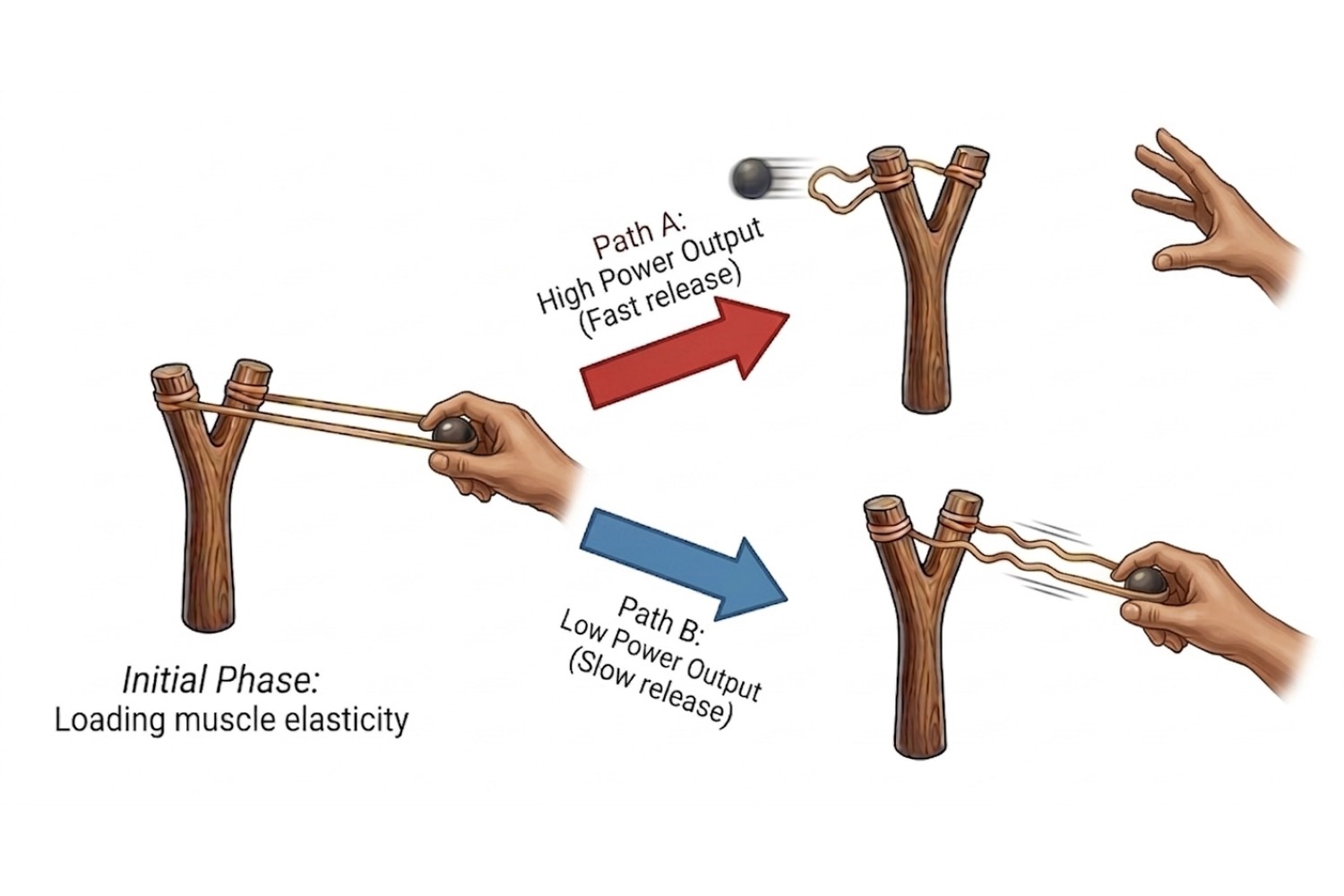
When muscles can deactivate quickly, increased stiffness improved performance by helping to propel movement, like a slingshot. However, when muscles deactivated more slowly, the same stiffness reduced performance, effectively working against the movement, like trying to fire a slingshot without releasing the elastic.
Additionally, the simulations revealed that muscle co-contraction (when opposing muscles activate at the same time) can be an optimal strategy for achieving high performance. This challenges the common assumption that co-contraction in older adults is simply a compensatory deficit - where the body adopts less efficient movement patterns to make up for age-related weakness.
Dr Delyle Polet, Postdoctoral Research Associate at the RVC and lead author of the study, said:

“One particularly striking result was that muscle co-contraction - often assumed to be a sign of impaired control in older adults - emerged as part of an optimal performance strategy in our model, suggesting its relationship with movement performance may be more nuanced than previously thought."
Professor Christopher T. Richards, Senior Lecturer at the RVC and Principal Investigator of the study, said:

“Beyond the results, I am very excited by the technique we used, which represents a relatively new direction for us. In particular, combining available data with a new modelling tool has unlocked our ability to simulate the multi-factorial effects of ageing. I hope that follow-on work will contribute towards increasingly realistic models of humans and animals which we can digitally age to study the consequences on behaviour.”
This research was funded by a Wellcome Trust Investigator Award (grant 215618/Z/19/Z).

Notes to Editors
This study was conducted at the RVC’s Structure and Motion Laboratory, which has a long-standing international reputation for multidisciplinary research and state-of-the-art facilities. Its work spans a wide range of scales and species, from individual muscle fibre contractions in a single animal to group dynamics in herds, and has helped explain everything from the mechanics of human walking to how animals move efficiently and how locomotion has evolved.
For more information, visit: https://www.rvc.ac.uk/research/facilities-and-resources/structure-and-motion
Reference
Polet DT, and Richards CT. (2026) How muscle ageing affects rapid goal-directed movement: mechanistic insights from a simple model. PLoS Computational Biology 22: e1014023. https://doi.org/10.1371/journal.pcbi.1014023
The full paper can be accessed at: https://journals.plos.org/ploscompbiol/article?id=10.1371/journal.pcbi.1014023
For media enquiries, please contact:
- rvc@plmr.co.uk
- Press Line: 0800 368 9520
About the RVC
- The Royal Veterinary College (RVC) is the UK's largest and longest established independent veterinary school and is a Member Institution of the University of London.
- It is one of the few veterinary schools in the world that hold accreditations from the RCVS in the UK (with associated recognition from the AVBC for Australasia, the VCI for Ireland and the SAVC for South Africa), the EAEVE in the EU, and AVMA in the USA and Canada.
- The RVC is ranked as the top veterinary school in the world in the QS World University Rankings by subject, 2026.
- The RVC offers undergraduate and postgraduate programmes in veterinary medicine, veterinary nursing and biological sciences.
- The RVC is a research-led institution, with 88% of its research rated as internationally excellent or world class in the Research Excellence Framework 2021.
- The RVC provides animal owners and the veterinary profession with access to expert veterinary care and advice through its teaching hospitals and first opinion practices in London and Hertfordshire.
You may also be interested in:
-
New RVC-led research advances understanding of the causes of childhood stunting

A new collection of research studies co-edited by, and featuring research from, the Royal …