New RVC research sheds light on orf management on UK sheep farms
New research from the Royal Veterinary College (RVC) on the prevalence and management of orf on UK sheep farms has identified opportunities to improve prevention and disease control. The findings will help inform proactive veterinary engagement, through discussion on treatment protocols, and prevention strategies to improve flock health and welfare.
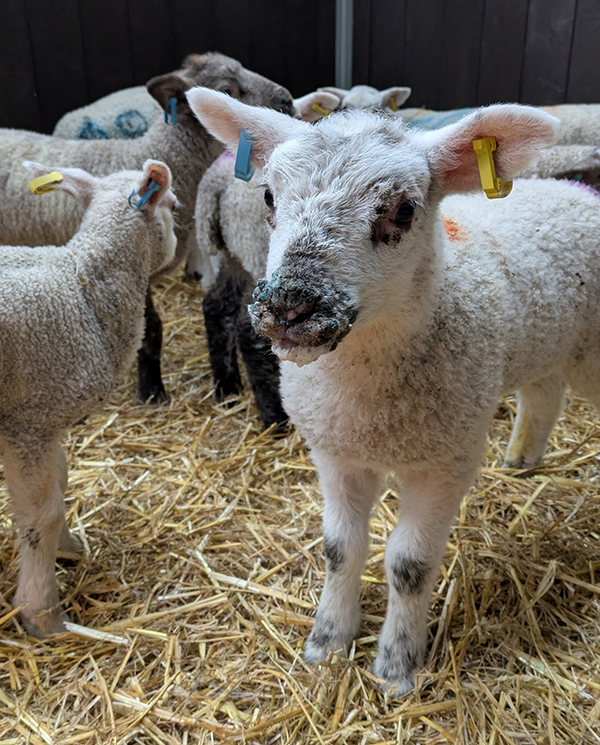
Orf is a common viral disease affecting sheep and goats and is widely recognised within the livestock industry. The disease typically causes lesions on the lips, muzzle and sometimes the udder and feet, which can lead to pain, reduced feeding, slower growth and increased mastitis risk. However, despite its importance for animal health, there is limited evidence in the UK on how frequently the disease occurs or how it is managed on farms. Farmers play a key role in identifying infection and deciding how and when to intervene, yet their experiences and management approaches have been largely underexplored. As a zoonotic disease (a disease that can be passed from animals to humans), improving understanding of current orf management is essential to support effective disease control and protect both animal and human health.
Led by Beth Reilly, Senior Teaching Fellow in Small Ruminant Health and Flock Management at the RVC, alongside JP Crilly, Lecturer in Small Ruminant Health and Flock Management, the study was conducted in collaboration with NoBACZ Healthcare Ltd, a company developing wound care solutions. The research team developed an anonymous online survey, which was distributed to sheep farmers across the UK via social media. In total, 421 UK sheep farmers participated, making this the first UK-based study of this scale to investigate farmers’ current orf treatment practices.
The findings revealed that orf remains widespread on UK sheep farms, with 88.8% of respondents reporting having identified orf lesions in their sheep. Farmers reported a median treatment cost of £5 per affected lamb and £100 per affected flock, highlighting the ongoing economic impact of the disease. Although uncomplicated orf cases do not require antibiotic treatment, topical antibiotic sprays were the most reported treatment used by 65.2% of respondents, while 26.7% used injectable antibiotics and 22.7% reported using both injectable and topical antibiotics. Notably, 13.6% of respondents reported using salt licks as part of orf treatment practices. However, only 34.5% of respondents reported using pain relief in affected animals. Despite the high reported prevalence of orf, veterinary involvement in diagnosis was limited, with only 23.8% of farmers flocks consulting a veterinarian when orf was suspected.
The study also highlighted important human health considerations. Nearly a third of respondents reported having contracted orf themselves. Notably, those who reported wearing gloves some or all the time were significantly less likely to contract orf, with their likelihood of infection only 64% of that of those who never wore gloves. This shows the importance of simple protective measures when handling affected animals.
Discussions between sheep farmers and veterinarians should be encouraged to cover current treatment options for orf lesions, the zoonotic risk, the importance of ensuring that other diseases with similar clinical presentations are not overlooked and that antimicrobials are used only when necessary. In addition, the study underscores the importance of increasing public awareness of the risk of zoonotic disease transmission from livestock, alongside the adoption of appropriate hygiene and PPE measures.
Beth Reilly, Senior Teaching Fellow in Small Ruminant Health and Flock Management at the RVC, said:
“Our online survey set out to establish current orf treatment practices on UK sheep holdings, as there is currently no licenced treatment. Eighty eight percent of respondents had seen orf on their holdings and reported a wide variety of treatments. An unexpected finding was the use of salt licks by 13.6% of respondents as part of orf treatment, highlighting the need for further research into the potential of this for orf treatment and control.”
David Charles, International Business Development Manager at NoBACZ Healthcare, said:
“Orf virus remains one of the big causes of economic and production loss to sheep farmers globally. Until recently, the true prevalence and economic impact have likely been underestimated, with the most recent previous work being done over a decade ago.
“At NoBACZ, we are proud to be a highly evidence-based company, and we were thrilled to work with the RVC on this research to improve our understanding of this challenging disease: widening the evidence-base and growing our sector's understanding of prevalence, economic impact and understanding what farmers were using.
“Crucially, this data has shown just how much antibiotic is used for what is a viral disease, clearly showing areas where we can support education and behaviour changes to lead to improved antimicrobial stewardship and increase the responsible use of antibiotics."
Building on this work, the RVC research team is now expanding its focus to investigate orf in UK goat holdings, where there is currently little published data on disease prevalence, management practices or economic impact. The new study aims to better understand how frequently orf occurs in goats and how it is treated and managed. Goat keepers across the UK are invited to take part in the survey, which can be found at: https://app.onlinesurveys.jisc.ac.uk/s/rvc/goat-orf-insights
Notes to Editors
The RVC is now conducting a survey on orf in UK goat holdings. The survey can be accessed at: https://app.onlinesurveys.jisc.ac.uk/s/rvc/goat-orf-insights The study has received ethical approval (URN SR2026 – 01942003)
Reference
Reilly B, et al. ‘Orf insights: establishing current prevalence, treatment practices and opinions of UK sheep farmers’, Small Ruminant Research, Volume 259, 2026.
The full paper can be accessed at: https://doi.org/10.1016/j.smallrumres.2026.107766
For media enquiries, please contact:
- rvc@plmr.co.uk
- Press Line: 0800 368 9520
About the RVC
-
- The Royal Veterinary College (RVC) is the UK's largest and longest established independent veterinary school and is a Member Institution of the University of London.
- It is one of the few veterinary schools in the world that hold accreditations from the RCVS in the UK (with associated recognition from the AVBC for Australasia, the VCI for Ireland and the SAVC for South Africa), the EAEVE in the EU, and AVMA in the USA and Canada.
- The RVC is ranked as the top veterinary school in the world in the QS World University Rankings by subject, 2025.
- The RVC offers undergraduate and postgraduate programmes in veterinary medicine, veterinary nursing and biological sciences.
- The RVC is a research-led institution, with 88% of its research rated as internationally excellent or world class in the Research Excellence Framework 2021.
- The RVC provides animal owners and the veterinary profession with access to expert veterinary care and advice through its teaching hospitals and first opinion practices in London and Hertfordshire.
You may also be interested in:
-
RVC researchers at forefront of new zoonotic funding programme

The RVC has been awarded more than £5 million as part of a multimillion pound research programme to …