Accreditation
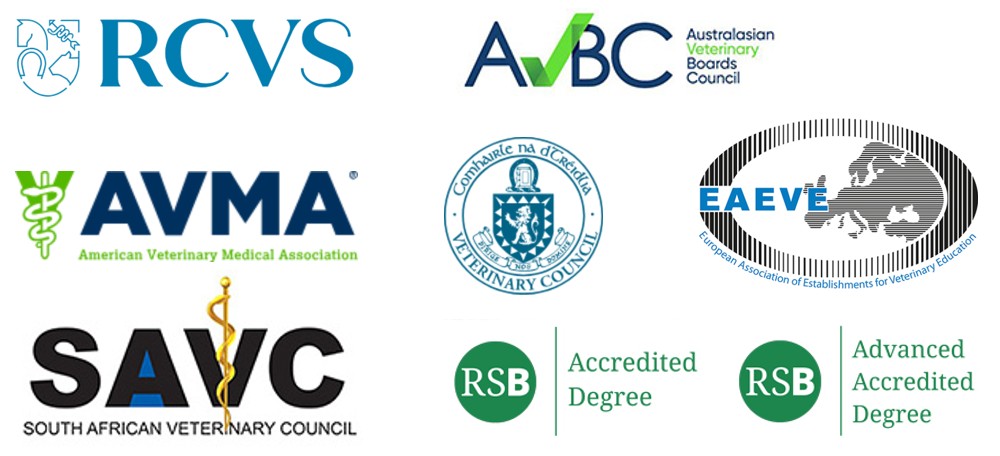
The RVC is one of the few veterinary schools in the world that hold accreditations from the Royal College of Veterinary Surgeons (RCVS) in the UK, the European Association of Establishments for Veterinary Education (ESEVT of the European Association of Establishments for Veterinary Education) in the EU, and the Council on Education of the American Veterinary Medical Association (AVMA) in the USA and Canada.
Furthermore, RCVS accreditation ensures RVC veterinary graduates are licensed to work in Ireland, Australia and New Zealand, as well as South Africa. In the case of our nursing courses, we are accredited in the UK by the RCVS and in the EU by the Accreditation Committee for Veterinary Nursing Education (ACOVENE), and our biological science programme is accredited by the Royal Society of Biology. Please refer to detailed information in the links below for information regarding accreditations specific to each course.
Veterinary Medicine
Royal College of Veterinary Surgeons (RCVS)
You will be entitled to work as a veterinarian in the UK as soon as you have earned your BVetMed degree and, have registered as a Member of the RCVS. Following the UK’s departure from the EU graduates seeking to work in EU member states, with the exception of Ireland, should consult the regulatory authority of the country in which they wish to pursue employment. The Federation of Veterinarians in Europe maintains a useful list of contacts here.
Reciprocal arrangements between the RCVS and the Australasian Veterinary Boards Council (AVBC), the Veterinary Council of Ireland (VCI), and the South African Veterinary Council (SAVC), allows BVetMed Graduates to practice in Australia, New Zealand, Ireland and South Africa without requiring any further qualifications, visa requirements notwithstanding.
- For further information about practicing in Australia and New Zealand, see www.avbc.asn.au
- For further information about practicing in South Africa, see www.savc.org.za
- For further information about practising in Ireland, see www.vci.ie
American Veterinary Medicine Association (AVMA)
The Council on Education (CoE) of the AVMA recognises the BVetMed degree as equivalent to those awarded by veterinary colleges in North America. Some major veterinary employers based in the USA and Canadas recruit actively among our final year students. If, after graduating, you intend to work in North America, for most veterinary jobs you will be required to have sat and passed the North American Veterinary Licensing Examination (NAVLE) as well as satisfying state/provincial veterinary board requirements where relevant – just as you would if graduating from any North American school, and notwithstanding any visa requirements. Passing the NAVLE does not guarantee a work visa in the USA or Canada. The RVC currently holds full AVMA accreditation.
The pass rate required by the CoE Standard for Outcomes Assessment is 80%. In 2024/25, the most recent year for which figures confirmed by the CoE are available, our pass rate was 86%.
The RVC is committed to ensuring ongoing support for our students wishing to take the NAVLE and provides 12-week NAVLE Support Programmes to help students to pass the NAVLE exam, starting in the penultimate year and leading up to each exam sit.
The NAVLE Support Programme provides:
- Funded access to VetPrep
- Funded access to three ICVA self-assessment tests
- Online sessions on revision techniques and NAVLE strategies
- 1:1 sessions to review preparation techniques and approaches to the exam
- Dedicated support resources
From 2025 the ICVA Veterinary Education Assessment (VEA) will be used with students in the penultimate year of their programme to help them get used to the test taking environment for the NAVLE and to help them approach their study for the NAVLE more effectively.
For current students and staff: The NAVLE area in the Student Hub on LEARN has a full range of FAQs about RVC’s accreditation status and about our NAVLE Support Programme (sign-in required) or write to navle@rvc.ac.uk
Accreditation Reports
The BVetMed degree underwent three separate professional body accreditation visits during 2025:
European Association of Establishments for Veterinary Education (EAEVE) -
Reaccredited to 2032
For the visit by EAEVE, the RVC prepared a Self-Evaluation Report and the visit report, as approved by ECOVE can be found on their web page via this link: https://www.eaeve.org/esevt/ser-and-visitation-report-of-visited-establishments
American Veterinary Medicine Association - Council on Education (AVMA CoE) -
Reaccredited to 2032
For the visit by AVMA CoE, the RVC prepared a Self Study Report. For further information about the accreditation process can be found via this link: avma.org/education/center-for-veterinary-accreditation/accredited-veterinary-colleges
Royal College of Veterinary Surgeons (RCVS)
Accreditation status pending
Following a visit in 2025, the visit report, as approved by the RCVS Education Committee can be found on their web page via this link: https://www.rcvs.org.uk/about-us/what-we-do/accrediting-qualifications/accrediting-veterinary-qualifications
The Australasian Veterinary Boards Council (AVBC) and the Veterinary Council of Ireland (VCI) formed part of the RCVS accreditation process in December 2025 and the outcomes from these will be forthcoming following completion of the RCVS process.
Any member of staff who has comments or concerns about compliance with the RCVS accreditation standards can submit an anonymous comment using the link on the intranet page The Royal Veterinary College Intranet.
Students can comment via the ‘Suggestion Box’ available in the Camden and Hawkshead Registry offices or the associated online form via link or QR code: https://docs.google.com/forms/
Veterinary Nursing
Royal College of Veterinary Surgeons (RCVS)
Reaccredited to academic year 2029/30
The Foundation Degree in Veterinary Nursing (FdSc) and Years 1-3 of the BSc Veterinary Nursing programme underwent an accreditation visit in 2025. The visit report as approved by the Veterinary Nurses Council is available on their webpage via this link: https://www.rcvs.org.uk/about-us/what-we-do/accrediting-qualifications/accrediting-veterinary-nursing-qualifications
As the RCVS is an affiliate member of the Accreditation Committee for Veterinary Nursing Education (ACOVENE), being an RCVS accredited course demonstrates that the programme meets EU standards, allowing for easier mobility for veterinary nurses across Europe.
Our Graduate and Postgraduate Certificates in Advanced Veterinary Nursing in:
-
Anaesthesia & Analgesia
-
Emergency & Critical Care
-
Medical Nursing
Are accredited in the UK by the Royal College of Veterinary Surgeons (RCVS) which means RCVS Registered Veterinary Nurses on these programmes have the option to gain a Certificate in Advanced Veterinary Nursing qualification awarded by the RCVS.
Candidates applying for and enrolling with the RCVS CertAVN in Medical Nursing, Emergency & Critical Care or Anaesthesia & Analgesia must meet the specific requirements as set out by the RCVS, to include:
Be on the current RCVS Register of Veterinary Nurses.
Have evidence of sufficient CPD from the point of entry onto the RCVS Register for Veterinary Nurses (in line with the RCVS requirements) prior to registration for the RCVS CertAVN.
During their studies, be employed in, or have agreed access to placement in, a suitable professional environment, tailored to their area of focused study.
Before commencing studies, enrol with the RCVS specifying the accredited university or awarding organisation where they plan to undertake their studies and the title of the qualification.
Registration for the RCVS CertAVN will be valid for up to five years. Further information: www.rcvs.org.uk
Biological Sciences
The following programmes underwent a professional body visit by the Royal Society of Biology during 2025.
Royal Society of Biology - Accredited to March 2031
These programmes have been accredited by the Royal Society of Biology following an independent and rigorous assessment. Accredited degree programmes contain a solid academic foundation in biological knowledge and key skills and prepare graduates to address the needs of employers. The accreditation criteria require evidence that graduates from accredited programmes meet defined sets of learning outcomes, including subject knowledge, technical ability and transferable skills.
- BSc (Hons) Animal Biology, Behaviour, Welfare and Ethics
- BSc (Hons) Biological Sciences
- BSc (Hons) Biological Sciences (Wildlife Health Sciences)
- BSc (Hons) Bioveterinary Sciences
Royal Society of Biology - Advanced Accreditation to March 2031
These programmes have been accredited by the Royal Society of Biology. Advanced Degree Accreditation by the Society recognises academic excellence in the biosciences, and highlights degrees that educate the research and development leaders and innovators of the future. The Advanced Accreditation criteria require evidence that graduates from the programme meet defined sets of learning outcomes, including gaining a substantial period of research experience.
- BSc (Hons) Animal Biology, Behaviour, Welfare and Ethics with placement year
- BSc (Hons) Biological Sciences with placement year
- BSc (Hons) Biological Sciences (Wildlife Health Sciences) with placement year
- BSc (Hons) Bioveterinary Sciences with placement year
- MSci (Hons) Applied Biological Research
- MSci (Hons) Applied Bioveterinary Research
- MSci (Hons) Biological Sciences
- MSci (Hons) Biological Sciences (Wildlife Health Sciences)
- MSci (Hons) Bioveterinary Sciences
- MSci (Hons) Applied Biological Research with placement year
- MSci (Hons) Applied Bioveterinary Research with placement year
- MSci (Hons) Biological Sciences with placement year
- MSci (Hons) Biological Sciences (Wildlife Health Sciences) with placement year
- MSci (Hons) Bioveterinary Sciences with placement year
Accreditation by the Royal Society of Biology recognises and supports the advancement of skills and education in the biosciences, throughout the UK and internationally. For more information see The Royal Society of Biology
Bachelor of Veterinary Science
The Royal College of Veterinary Surgeons (RCVS) quality assures veterinary degrees at UK vet schools by means of specific accreditation standards.
Graduates from accredited schools join the RCVS register as members allowing them to practise veterinary surgery in the UK.
Aberystwyth University, the Royal Veterinary College and the RCVS are working together to ensure that the new degree meets these standards and that graduates will be eligible for registration. Under the Veterinary Surgeons Act 1966, veterinary degrees must have a “recognition order” from the Privy Council before graduates can automatically be eligible for registration with the RCVS.
The Privy Council will take advice from RCVS on this. The process takes a number of years as full approval cannot be considered until after the RCVS undertakes a formal inspection of the full course and its standards in 2026 when the first cohort of students will have completed their degrees.
Until that time, both institutions are liaising regularly with the RCVS to ensure that progress towards accreditation is maintained.
Should any unforeseen issues arise, the Veterinary Surgeons Act includes a provision to help ensure that those completing their final exams in an as-yet-unapproved degree may still be allowed to register, in that the Privy Council may invite the RCVS to set examinations for any students attending a non-approved UK veterinary degree course, or alternatively appoint RCVS External Examiners to oversee the standard of the final year examinations. Students who pass the RCVS-controlled examinations would then be able to register with the RCVS and practise as veterinary surgeons in the UK, regardless of the outcome of the degree’s accreditation process. This is in line with the arrangements for any new veterinary degree programmes.
Please note that the BVSc degree is not accredited by the American Veterinary Medical Association (AVMA) nor by EAEVE (European Association of Establishments for Veterinary Education).