
Introduction to A(SP)A and 2025 Facts and Figures
Facts
Introduction to A(SP)A
The use of animals in research at the RVC is regulated by the Animals (Scientific Procedures) Act 1986, which governs work involving all living vertebrates and cephalopods (such as octopus and squid). You can find the full Act here: https://www.legislation.gov.uk/ukpga/1986/14/contents
What counts as a regulated procedure?
A procedure is considered “regulated” under A(SP)A if it is carried out on a protected animal and may cause pain, suffering, distress, or lasting harm equivalent to, or greater than, the discomfort caused by inserting a hypodermic needle performed in accordance with good veterinary practice. This threshold determines whether an activity must be licensed and reported.
Genetically altered animals
Animals that have been genetically altered (GA) must also be reported if they are:
- bred under A(SP)A, or
- used in regulated procedures.
These animals may be naturally occurring mutants or genetically engineered (often referred to as genetically modified).
Licensing and Oversight
Anyone carrying out regulated procedures must:
- Be trained, and
- Hold a Personal Licence, granted by the Secretary of State.
All work must take place:
- Under an approved Project Licence, which describes the programme of work, and
- At a licensed Scientific Procedure Establishment, operating under an Establishment Licence.
Licensing and oversight are managed by the Animals in Science Regulation Unit (ASRU) on behalf of the Secretary of State for the Home Office.
Annual Reporting
As a condition of holding a Project Licence, licence holders must submit an Annual Return of Procedures to the Home Office each January.
This report includes:
- The number and type of animals used
- The procedures carried out
- The severity level experienced by each animal
These data form the basis of the published national statistics and are also used to generate the figures presented below.
Note: The RVC also cares for a small number of animals under Home Office Project Licences that have secondary availability at our establishment (meaning the licence is held at another establishment, but the licence holders are authorised to conduct some of their work at the RVC). The use of these animals is reported by the institution where the Project Licence has primary availability, and therefore are not included in the figures presented here.
Severity Categories
Severity categories reflect the level of discomfort experienced during a procedure.
The Home Office defines five categories:
1. Sub-threshold
A sub-threshold procedure is one where the animal does not actually experience any significant discomfort, and the level of effect stays below that of a standard injection.
This can include, for example, a genetically altered animal that does not experience any harm linked to the genetic alteration.
2. Mild
Short-lasting and minor effects, such as an injection or a routine blood sample.
3. Moderate
More significant effects, such as surgery performed under general anaesthesia combined with post-operative analgesia.
4. Severe
Procedures that could cause a level of suffering that a typical person would not wish to endure—for example, a heart attack. Animals found dead following procedures are categorised as severe unless there is clear evidence supporting a lower classification.
5. Non-recovery
The animal undergoes a procedure under general anaesthesia and does not regain consciousness. Because the animal never wakes, it does not experience any pain or distress after losing consciousness.
Categories of regulated procedures
Each regulated procedure is assigned to one of the following categories:
- Basic/fundamental Research: this includes exploratory research aimed at increasing knowledge of biological systems in humans or animals and improving understanding of how the body functions. This type of research seeks to generate new information, which may later form the basis for developing new treatments or procedures for animals or people.
- Breeding and Maintenance: this category covers animals that are allowed to breed naturally, where the act of breeding could result in offspring with abnormalities. Because these abnormalities may cause harm, the breeding process falls within the scope of regulated procedures under A(SP)A.
- Translational and applied research: Applied research involves using existing knowledge to address a specific goal, such as understanding a disease pathway, identifying potential drug targets or investigating potential treatments. This work may represent an incremental step towards achieving the overall aim.
Translational research is closely related to applied research. For reporting purposes in animal research statistics, translational and applied research are grouped together. In medical and veterinary contexts, translational research is often viewed as bridging the gap between basic/ fundamental research and practical solutions that can benefit human and/or animal health.

Figures
The following sections provide the 2025 figures associated with the regulatory definitions set out above.
How many animals were used by the RVC in 2025?
In 2025, a total of 4428 animals had regulated procedures carried out on them at the RVC under Home Office project licences.
Scientific Procedures
A total of 5,154 scientific procedures were carried out at the RVC in 2025. These figures represent the number of procedures—not the number of animals—as an individual animal may undergo more than one procedure.
The numbers of scientific procedures carried out (per species):
|
|
Numbers |
Percentage |
|
Alpacas* |
1 |
0.01 |
|
Cattle |
573 |
11.12 |
|
Dogs* |
17 |
0.33 |
|
Domestic fowl |
396 |
7.68 |
|
Mice |
1990 |
38.61 |
|
Pigs* |
44 |
0.85 |
|
Sheep* |
8 |
0.16 |
|
Zebrafish |
2125 |
41.23 |
|
Total |
5154 |
|
*Listed as “other species” in the chart below. 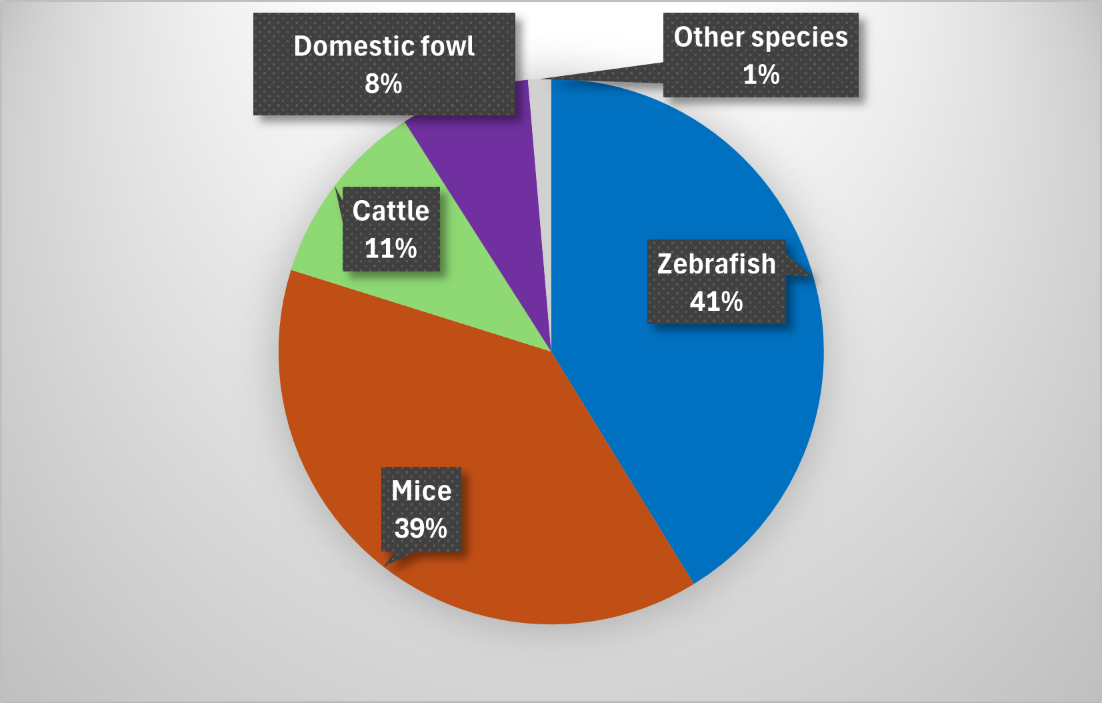
*‘Other species’ includes alpacas, dogs, sheep and pigs. These species each represent less than 1% of animals used and are grouped together in the chart for clarity. Full details are provided in the table above.
The numbers of animals used in regulated procedures (by species):
|
|
Numbers |
Percentage |
|
Alpaca* |
1 |
0.02 |
|
Cattle |
85 |
1.92 |
|
Dogs* |
17 |
0.38 |
|
Domestic fowl |
396 |
8.94 |
|
Mice |
1999 |
45.15 |
|
Pigs* |
44 |
0.99 |
|
Sheep* |
8 |
0.18 |
|
Zebrafish |
1878 |
42.42 |
|
Total |
4428 |
|
*Listed as “other species” in the chart below. 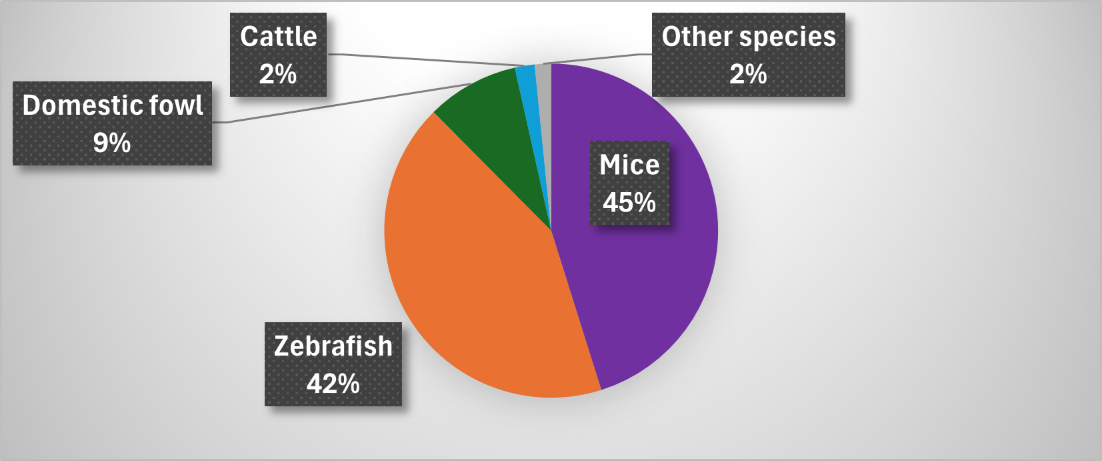
‘Other species’ includes alpacas, dogs, sheep and pigs. These species each represent less than 1% of animals used and are grouped together in the chart for clarity. Full details are provided in the table above.
The major species used were mice, zebrafish, domestic fowl and cattle.
Domestic fowl were used primarily for applied research aimed at developing new treatments to improve the welfare of commercially reared chickens globally.
Cattle were mainly involved in research investigating how factors in both calves and their dams influence immune development, and how this relates to calf health, performance and survival. The study monitored how immunity is transferred and develops in the first weeks of life, helping to identify calves at higher risk of disease—a major welfare and productivity concern. Weekly blood sampling and health assessments were carried out on female dairy calves and their dams on a single farm. All animals experienced no adverse effects, no mortality occurred, and all individuals returned to the herd after the study. The resulting data is now being analysed to support improved calf‑rearing practices.
Animals killed or died as a result of procedures
The figures below show the number of animals that were either humanely killed or died as a result of regulated procedures undertaken in 2025
|
Species |
Number killed |
% |
|
Alpaca* |
1 |
0.04 |
|
Cattle* |
6 |
0.22 |
|
Dogs* |
7 |
0.26 |
|
Domestic fowl |
396 |
14.80 |
|
Mice |
1923 |
71.88 |
|
Pigs |
44 |
1.65 |
|
Sheep* |
8 |
0.30 |
|
Zebrafish |
290 |
10.85 |
|
Total |
2675 |
|
*Listed as “Other species” in the chart below. 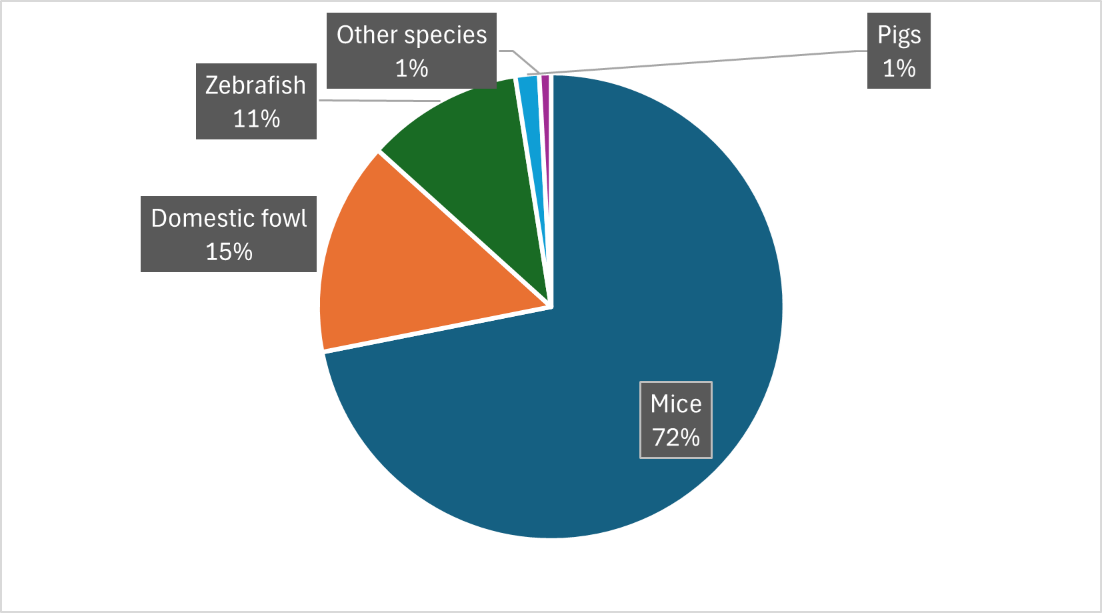
‘Other species ’ includes alpacas, cattle, dogs and sheep. These species each represent less than 1% of animals killed and are grouped here for chart clarity. Full details remain available in the table above.
Procedures by research category
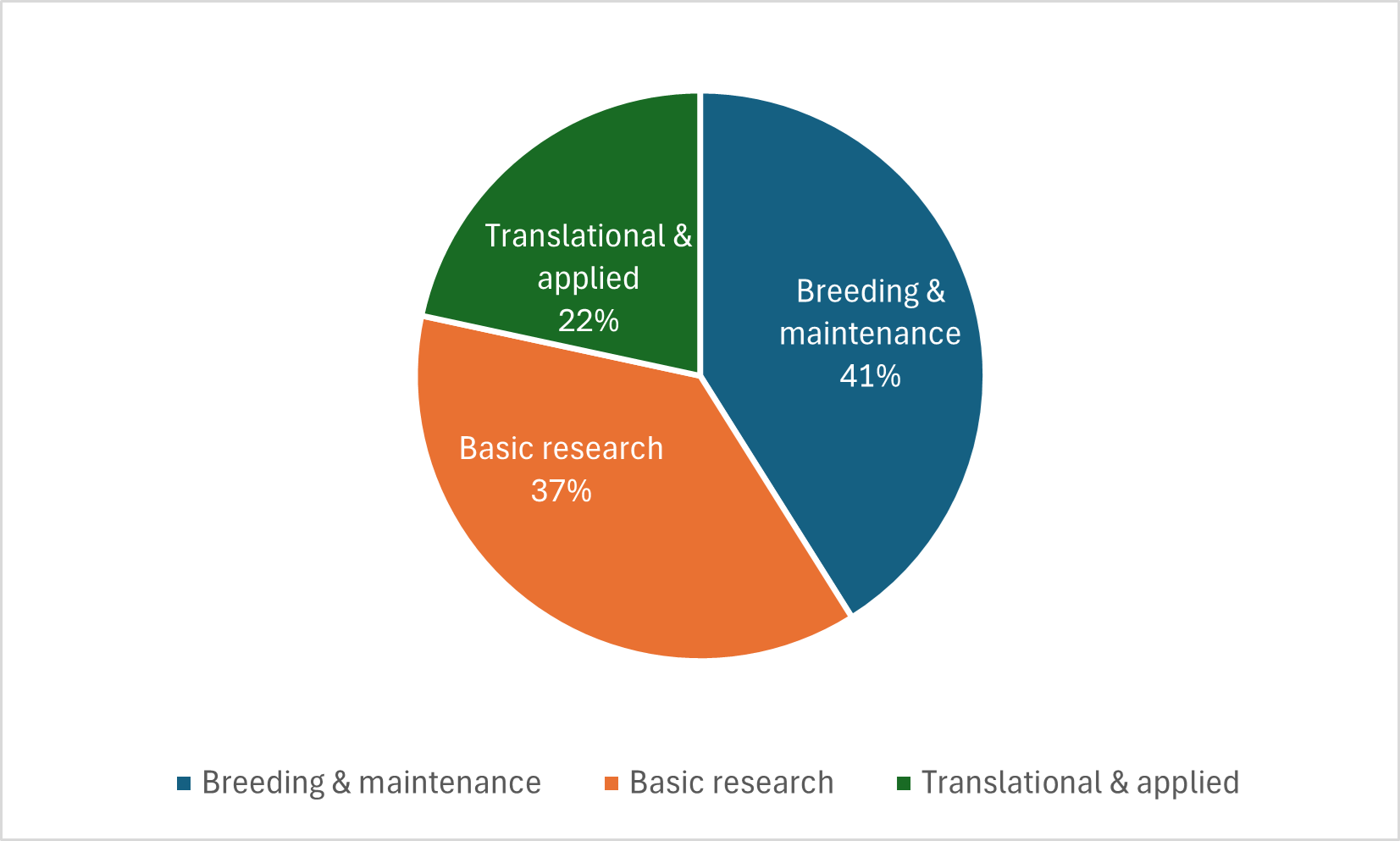
The figures below show the number of regulated procedures carried out in 2025 under each of the research categories described in the Facts section.
Breeding & maintenance procedures accounted for the largest proportion of work (41%), followed by basic research (37%) and translational/applied research (22%).
|
|
Basic Research |
Breeding & Maintenance |
Translational and applied research |
Total |
|
Procedures |
1923 |
2117 |
1114 |
5154 |
|
Percentage |
37.31 |
41.08 |
21.61 |
|
Severity of procedures
Severity categories reflect the level of discomfort experienced during a procedure. The table and chart below show how procedures carried out in 2025 were classified according to the Home Office definitions described in the Facts section.
In 2025:
- Sub‑threshold: 1,881 (36.50%)
- Mild: 2,723 (52.83%)
- Moderate: 370 (7.18%)
- Severe: 167 (3.24%)
- Non‑recovery: 13 (0.25%)
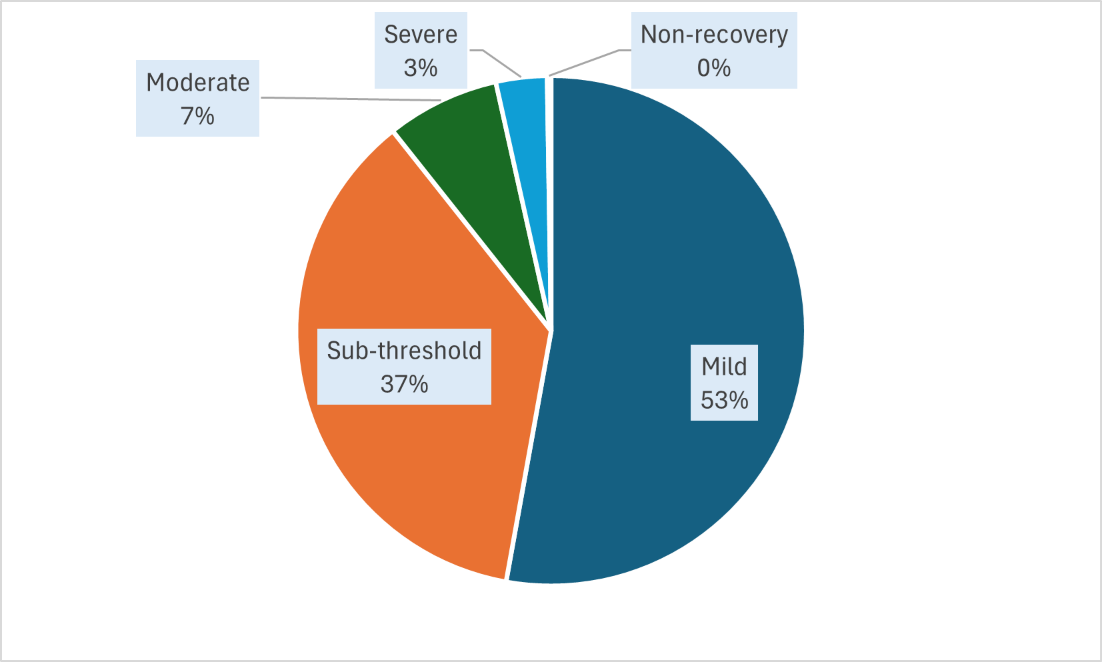
Most procedures were classified as mild or sub‑threshold (89.5% combined). Severe procedures accounted for less than 3.5% of all work, and non‑recovery procedures represented just 0.25%.
(Severity categories are defined by the Home Office.)
Client owned animals
At the RVC, some of our research involves client‑owned animals—pets who are already receiving veterinary care from us. These studies help us improve understanding of animal health and develop better ways to diagnose or treat diseases. Sometimes, a study may involve doing something that is not part of the animal’s normal clinical care, such as taking an additional blood sample purely for research purposes. Because these procedures are carried out for research rather than the direct clinical benefit of the animal, they cannot be done under routine veterinary legislation (the Veterinary Surgeons Act). Instead, they must be carried out under the Animals (Scientific Procedures) Act (A(SP)A), which provides strict safeguards to protect animal welfare.
All owners give full, informed consent before their animals take part. Participation is completely voluntary, and choosing not to take part—or deciding to withdraw—never affects the care the animal receives. Animals return to their owners after each procedure.
We also look after a dog colony in which we care for dogs affected by Duchenne Muscular Dystrophy. As part of managing this colony, puppies that are not affected by the disease are rehomed as part of our commitment to giving them the best quality of life.
For more information about these types of studies and the animals involved see Research using Client-owned Animals.
Animals rehomed or returned to owners
The following numbers of animals were either rehomed or returned to their owners or herds:
|
Animals rehomed |
|||
|
|
Rehomed |
Returned to owners * |
Returned to herd |
|
Cattle |
|
|
79 |
|
Dogs |
9 |
10 |
|
|
Hamsters ** |
2 |
|
|
|
Mice ** |
10 |
|
|
|
Turkey |
1 |
|
|
* these were client-owned animals where their owners gave permission for their animals to be used in studies conducted under A(SP)A (see above for further information).
** These were teaching animals used for veterinary students to learn the best ways to handle and look after these species.
Case Studies
We have put together a series of case studies that explain how and why we use animals in research at the RVC.
The proportion of our funded research that relates to animal work
As a measure of the proportion of our research that involves experimental animals, the amount of external grant funding used to cover the costs of purchasing and keeping the animals has been calculated as a percentage of the total non-pay spend from external grants. This is 14.5%
|
2024/25 |
|
|
Total Non-pay expenditure on research activities |
3,125,000 |
|
Consumables |
204,387 |
|
% |
6.5% |
The numbers of animals that have had procedures carried out on them at the RVC each year since 2017
|
Year |
2017 |
2018 |
2019 |
2020 |
2021 |
2022 |
2023 |
2024 |
2025 |
|
Alpacas |
|
|
2 |
|
|
1 |
1 |
4 |
1 |
|
Amphibians |
4 |
24 |
1 |
|
|
|
|
|
|
|
Birds - other |
4 |
|
|
|
|
|
|
|
|
|
Cats |
30 |
4 |
|
|
|
|
|
|
|
|
Cattle |
12 |
17 |
17 |
12 |
11 |
4 |
1 |
105 |
573 |
|
Dogs |
43 |
33 |
51 |
18 |
42 |
43 |
108 |
95 |
17 |
|
Domestic Fowl |
627 |
2814 |
2175 |
377 |
571 |
743 |
607 |
405 |
396 |
|
Equidae |
288 |
270 |
245 |
7 |
4 |
19 |
|
|
|
|
Geese |
|
|
30 |
|
|
|
|
|
|
|
Mice |
3919 |
4162 |
4861 |
5394 |
4759 |
5759 |
2514 |
3153 |
1990 |
|
Pigs |
165 |
179 |
80 |
60 |
90 |
72 |
141 |
86 |
44 |
|
Rats |
3565 |
6108 |
5428 |
6175 |
192 |
206 |
130 |
8 |
|
|
Reptiles |
10 |
|
|
|
|
|
|
|
|
|
Sheep |
70 |
53 |
44 |
54 |
44 |
18 |
27 |
13 |
8 |
|
Tinamous |
|
4 |
|
|
|
|
|
|
|
|
Turkeys |
120 |
28 |
|
|
|
|
|
|
|
|
Zebrafinch |
|
|
|
|
|
|
18 |
|
|
|
Zebrafish |
2324 |
2995 |
5078 |
1686 |
1256 |
1599 |
2401 |
1577 |
2125 |
|
Total per year |
11181 |
16691 |
18012 |
13783 |
6969 |
8464 |
5948 |
5446 |
5154 |
Numbers of animals killed following procedures carried out since 2017
|
Year |
2017 |
2018 |
2019 |
2020 |
2021 |
2022 |
2023 |
2024 |
2025 |
|
Alpacas |
|
|
|
|
|
|
|
1 |
1 |
|
Amphibians |
4 |
24 |
1 |
|
|
|
|
|
|
|
Birds - other |
4 |
|
|
|
|
|
|
|
|
|
Cats |
|
|
|
|
|
|
|
|
|
|
Cattle |
|
|
|
|
|
|
|
|
6 |
|
Dogs |
17 |
|
4 |
8 |
5 |
13 |
20 |
25 |
7 |
|
Domestic Fowl |
627 |
2814 |
2175 |
377 |
571 |
743 |
607 |
404 |
|
|
Equidae |
|
|
10 |
3 |
4 |
|
|
|
|
|
Geese |
|
|
30 |
|
|
|
|
|
|
|
Mice |
3917 |
4144 |
4861 |
5394 |
4759 |
5759 |
2514 |
3150 |
1923 |
|
Pigs |
147 |
179 |
80 |
60 |
90 |
72 |
141 |
86 |
44 |
|
Rats |
3545 |
6108 |
5420 |
6166 |
192 |
206 |
130 |
8 |
|
|
Reptiles |
10 |
|
|
|
|
|
|
|
|
|
Sheep |
70 |
53 |
40 |
49 |
44 |
18 |
27 |
13 |
8 |
|
Tinamous |
|
4 |
|
|
|
|
|
|
|
|
Turkeys |
120 |
28 |
|
|
|
|
|
|
|
|
Zebrafinch |
|
|
|
|
|
|
18 |
|
|
|
Zebrafish |
1989 |
2374 |
4976 |
1214 |
1231 |
1385 |
769 |
717 |
290 |
|
Total per year |
10450 |
15728 |
17597 |
13271 |
6896 |
8196 |
4226 |
4404 |
|
Total numbers of animals rehomed/returned to owners/returned to herd since 2017*
|
Year |
Alpacas |
Cats |
Cattle |
Dogs |
Domestic Fowl |
Equidae |
Pigs |
Turkeys |
Total per year |
|
2017 |
|
30 |
|
28 |
|
277 |
18 |
|
353 |
|
2018 |
|
4 |
|
29 |
|
265 |
|
|
298 |
|
2019 |
2 |
|
17 |
33 |
|
236 |
|
|
288 |
|
2020 |
|
|
10 |
24 |
|
|
|
|
34 |
|
2021 |
|
|
10 |
53 |
|
|
|
|
|
|
2022 |
|
|
|
69 |
8 |
17 |
|
|
94 |
|
2023 |
|
|
|
123 |
|
|
|
|
123 |
|
2024 |
3 |
|
105 |
72 |
|
|
|
|
180 |
|
2025 |
|
|
79 |
19 |
|
|
|
1 |
99 |
*Does not include teaching animals
For details of animals used in previous years, please see: