New RVC study challenges common beliefs on desirable behaviours in designer ‘Doodle’ crossbreeds
The study reveals novel insights into the behaviour of Cockapoos, Cavapoos and Labradoodles which can support owners considering which type of dog to purchase
A new study from the Royal Veterinary College (RVC) has revealed that three popular designer Poodle-crossbreeds (often generically called Doodles), Cockapoos, Labradoodles and Cavapoos, often display higher levels of undesirable behaviour than their purebred parent breeds. As the first UK study of its kind, these findings challenge widespread public perceptions that these Doodle breed dogs are easier to train or especially suited to family homes with children compared to purebred dogs. The results also provide vital information which can assist prospective owners deciding which type of dog to welcome into their family.
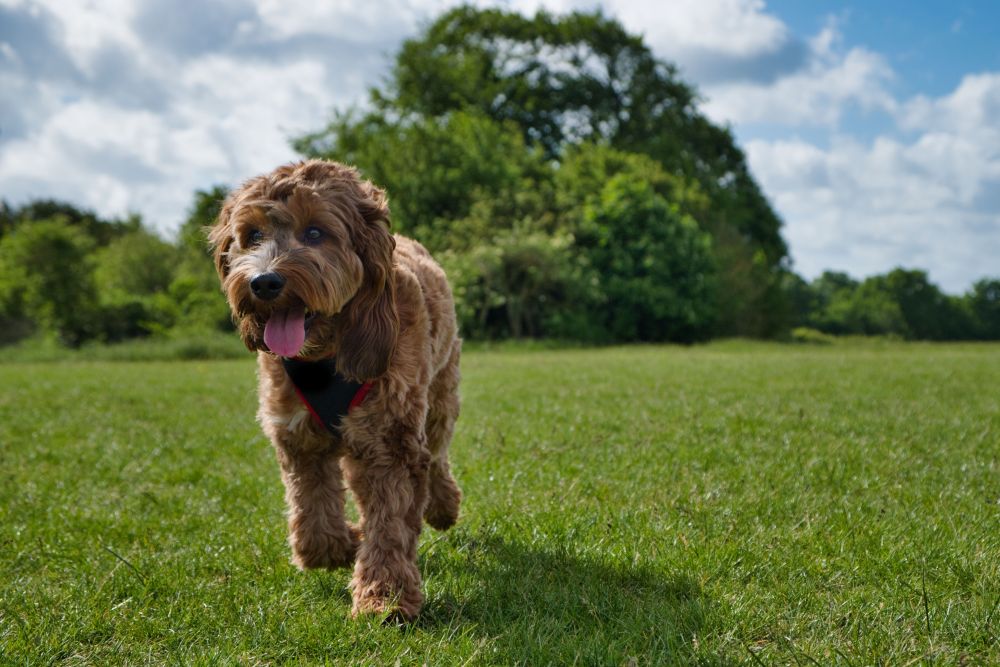
Intentional crossbreeding between established ‘purebred’ dogs is increasingly used to create new ‘designer’ dog breeds. For example a Labradoodle is a designed cross between a Labrador Retriever and Poodle. The popularity of these new designer crossbreeds has surged in the UK over the past decade, and particularly since the pandemic, with many designer crossbreeds now outnumbering their purebred parent breeds.
Previous RVC research revealed that the physical health of common Doodles is broadly similar to that of their parent breeds, despite designer crossbreed owners often being drawn to these dogs by a perception of superior health to purebreds. This new study expands on these previous health comparisons and now suggests that neither health nor behavioural advantages should be assumed for Doodles simply because they are crossbreeds.
The RVC cross-disciplinary research team undertaking this study included Dr Rowena Packer, Senior Lecturer in Companion Animal Behaviour and Welfare Science, Dr Dan O’Neill, Professor of Companion Animal Epidemiology, and Gina Bryson, RVC Research Assistant, amongst others.
Conducting this research, the team used a large online survey with valid responses collected for 9,402 UK dogs to investigate the behaviour of three popular designer Doodle breeds – Cockapoo, Labradoodle and Cavapoo. Behaviours were then compared between the Doodles and their purebred parent breeds, including Cocker Spaniels; Cavalier King Charles Spaniels; Labrador Retrievers; and Toy, Miniature, and Standard Poodles. Behaviour was assessed using the validated Canine Behavioural Assessment and Research Questionnaire (C-BARQ) which quantifies diverse behavioural challenges including aggression, fear and anxiety, separation-related behaviour and attention-seeking.
The results show that designer Doodles differed from their purebred parents in approximately 54% of behavioural comparisons. Where differences were identified, Doodles showed more undesirable behaviours in 82% of comparisons. Some of these common undesirable behaviours included non-social fear (e.g. fear of traffic, loud noises); separation-related problems (e.g. vocalisation and destructiveness when left alone); and excitability (e.g. strong reactions to exciting events such as walks and doorbells). These undesirable behaviours can have real impacts, with some owners experiencing difficulty when training their dog or feeling trapped and unable to leave their dog alone. Doodles showed less undesirable behaviours in only 18% of the comparisons where a difference was identified, for example Labradoodles scored lower for dog rivalry (e.g., conflict with dogs they live with) compared to Poodles.
Considerable variation between the three individual Doodle breeds was also identified, demonstrating that designer crossbreeds should not be treated as a single, uniform group in terms of behaviour. For example, Cockapoos displayed a higher level of undesirable behaviours compared to their purebred parent breeds, exceeding that seen in Cavapoos and Labradoodles. In particular, Cockapoos showed higher levels of aggressive behaviours, such as owner-directed aggression and dog rivalry, than their purebred parents.
Additionally, owners of designer Poodle-crossbreeds were more likely to rely on non-professional sources of training advice, such as social media or friends and family, which can be highly variable in quality and sometimes misleading.
The results of this study highlight the importance of owners thoroughly exploring the characteristics of any breed, purebred or crossbred, prior to acquiring a dog. This research should include using reliable sources (e.g., from behavioural professionals) to help ensure their expectations align with the breeds’ known behaviour. It also underscores the importance of prospective owners meeting the biological parents of any puppy they are considering acquiring so that the parents’ behaviour can also be appraised prior to purchase.
Dr Rowena Packer, Senior Lecturer in Companion Animal Behaviour and Welfare Science at the RVC and senior author of the paper, said:
“Realistic expectations are key to happy dog ownership. When expectations and reality don’t align, both dogs and owners can struggle. Preconceived beliefs, such as the idea that designer-crossbreeds are naturally easy to train or are safe with children, can have serious consequences if they aren’t supported by evidence. Our research shows that many designer-crossbreeds do not always behave as expected, particularly regarding training, anxiety and aggression, which were more common than in their parent breeds. We also found that not all ‘Doodles’ are alike, with Cockapoos tending to display more undesirable behaviour compared to Labradoodles and Cavapoos, highlighting that each breed is unique. By providing reliable scientific data, we can help puppy buyers to make better-informed choices that support both human wellbeing and canine welfare.”
Professor Dan O’Neill, Professor of Companion Animal Epidemiology at the RVC and co-author of the paper, said:
“Humanity started inventing new dog breeds 200 years ago and we haven’t stopped since. We are still learning from our mistakes as well as successes. This new paper shows that relying on the cute ‘teddy bear’ appearance of Doodles to assume these dogs behave like stuffed toys is just not safe. Looks can be deceiving – even in dogs.”
Gina Bryson, Research Assistant at the RVC and first author of the paper, said:
“This study highlights the importance for all prospective and current dog owners consulting reliable information sources pre-purchase to educate themselves on what to expect from different dog breeds, including crossbreeds. The immense popularity of Poodle crosses strongly suggests these dogs are here to stay and consequently, this paper is a timely resource that can provide both owners and veterinary professionals with scientifically backed information when making decisions about which breed is right for them, or giving advice about breed choice.”
Notes to Editors
Reference
Bryson GT, O'Neill DG, Belshaw Z, Brand CL, Packer RMA (2026) Comparing undesirable behaviours between ‘designer’ Poodle-cross dogs and their purebred progenitor breeds. PLoS One 21(2): e0342847.
The full paper is available from PLOS ONE and can be accessed at:
https://doi.org/10.1371/journal.pone.0342847
For media enquiries, please contact:
- rvc@plmr.co.uk
- Press Line: 0800 368 9520
About the RVC
- The Royal Veterinary College (RVC) is the UK's largest and longest established independent veterinary school and is a Member Institution of the University of London.
- It is one of the few veterinary schools in the world that hold accreditations from the RCVS in the UK (with reciprocal recognition from the AVBC for Australasia, the VCI for Ireland and the SAVC for South Africa), the EAEVE in the EU, and the AVMA in the USA and Canada.
- The RVC is ranked as the top veterinary school in the world in the QS World University Rankings by subject, 2024.
- The RVC offers undergraduate and postgraduate programmes in veterinary medicine, veterinary nursing and biological sciences.
- The RVC is a research-led institution, with 88% of its research rated as internationally excellent or world class in the Research Excellence Framework 2021.
- The RVC provides animal owners and the veterinary profession with access to expert veterinary care and advice through its teaching hospitals and first opinion practices in London and Hertfordshire.