Pioneering research from the RVC reveals early imaging biomarkers of osteoarthritis in dogs
Novel research from the Royal Veterinary College (RVC) has identified new markers to look for in the early diagnosis of osteoarthritis in dogs, using high-resolution three-dimensional bone mapping. This advanced form of evaluation has not previously been performed, even in humans, and has generated new insights into osteoarthritis. The findings will help improve understanding of the earliest changes that occur within the osteoarthritic joint, offering a potential opportunity for much earlier detection of the disease in both dogs and humans.
Osteoarthritis is an extremely common condition, affecting approximately one in seven people worldwide and one in five dogs. It is a major cause of chronic pain and disability, with more than 600 million individuals globally and around 10 million people in the UK currently living with the disease. These numbers are predicted to double by 2050, according to the World Health Organization¹.
While osteoarthritis can affect any dog breed, research from the RVC’s VetCompass programme has shown that certain breeds, including Golden Retriever, Labrador Retriever, Rottweiler and German Shepherd, are particularly susceptible. Current treatments in both humans and dogs largely focus on pain management or joint replacement surgery. Unfortunately, early diagnosis remains elusive, despite being widely recognised as essential for developing more effective strategies to slow or potentially reverse disease progression.
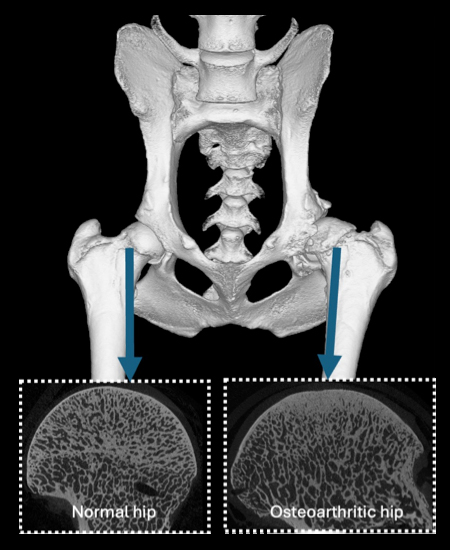
Conducting this research, the RVC team used ultra-high-resolution micro-computed tomography (CT) to map the entire femoral head (the ball of the hip joint) in three dimensions. They studied osteoarthritic tissues from dogs with osteoarthritis treated with total hip replacement surgery at the RVC’s Queen Mother Hospital for Animals. Previous research in human samples has only analysed localised small samples, whereas with analysis of the entire bone structure in 3D, the researchers identified that different areas of the femoral head simultaneously responded differently.
Notably, the findings revealed that in the earliest stages of osteoarthritis, the inner regions predictably change their bone structure pattern, allowing early identification of osteoarthritis. As the disease progresses, the dense layer of bone immediately below the joint surface becomes more porous in proportion to the increasing severity of osteoarthritis, distinguishing mild from severe changes.
The research is a key milestone towards the earlier detection of the disease in dogs. This work has also been published in the leading human journal, Osteoarthritis and Cartilage, highlighting the value of a One Health approach to disease research.
Moving forward, the next steps are to match these changes with clinical scans to develop improved non-invasive approaches to assessing joint health at much earlier stages of disease. The study builds on the RVC’s long-standing expertise in orthopaedic surgery and musculoskeletal research, reinforcing its position as a leader in both companion animal care and translational medicine.
Professor Richard Meeson, Professor of Orthopaedics at the RVC, and senior author of the paper, said:
“Osteoarthritis is a devastating disease affecting both people and our pets. Every day in our orthopaedic referral clinic, I see dogs suffering from its severe effects. What is truly exciting is that through our clinical work, we can transform the lives of dogs through hip replacement surgery, and we have also been able to drive forward pioneering research at the RVC. This research has provided new insights into the disease and, crucially, brings us closer to diagnosing osteoarthritis at a much earlier stage.”
Dr Gareth Jones, former PhD Student at the RVC and lead author of the paper, said:
“Uniquely, our pet dogs share our environment and lifestyles and often develop the same diseases. It is therefore pleasing to see greater acceptance of the opportunity to learn from veterinary diseases to also understand human diseases, through our One Health approach, with this work on dogs being published in such an esteemed human research journal.”
The RVC is currently recruiting for a three-year funded PhD research studentship based in London which will investigate how bone marrow lesions (BMLs) and subchondral bone cysts (SBCs) may hold the key to early detection of osteoarthritis (funded by PetPlan). Application deadline is 19 April 2026.
| Find out more about the PhD studentship here→ |
Notes to Editors
For more information regarding the PhD studentship, please visit: https://www.rvc.ac.uk/study/postgraduate/phd/studentships/osteoarthritis
¹ https://www.thelancet.com/journals/lanrhe/article/PIIS2665-9913(23)00163-7/fulltext
Reference
Gareth M.C. Jones, Henry Mosey, Mark Hopkinson, Andrew A. Pitsillides and Richard L. Meeson, Whole bone µCT 3-dimensional mapping reveals new early imaging biomarkers of osteoarthritis. Running Title: 3D µCT Mapping Identifies OA Biomarkers, Osteoarthritis and Cartilage, (2026) doi: https://doi.org/10.1016/j.joca.2026.02.008
The full paper can be accessed at: https://www.sciencedirect.com/science/article/abs/pii/S1063458426006783
Previous RVC VetCompass Osteoarthritis studies can be accessed at: https://www.nature.com/articles/s41598-018-23940-z; https://www.nature.com/articles/s41584-019-0202-1; and https://www.nature.com/articles/s41584-019-0202-1
For media enquiries, please contact:
- rvc@plmr.co.uk
- Press Line: 0800 368 9520
About the RVC
- The Royal Veterinary College (RVC) is the UK's largest and longest established independent veterinary school and is a Member Institution of the University of London.
- It is one of the few veterinary schools in the world that hold accreditations from the RCVS in the UK (with associated recognition from the AVBC for Australasia, the VCI for Ireland and the SAVC for South Africa), the EAEVE in the EU, and AVMA in the USA and Canada.
- he RVC is ranked as the top veterinary school in the world in the QS World University Rankings by subject, 2026.
- The RVC offers undergraduate and postgraduate programmes in veterinary medicine, veterinary nursing, and biological sciences.
- The RVC is a research-led institution, with 88% of its research rated as internationally excellent or world class in the Research Excellence Framework 2021.
- The RVC provides animal owners and the veterinary profession with access to expert veterinary care and advice through its teaching hospitals and first opinion practices in London and Hertfordshire.
- http://www.rvc.ac.uk
